- Washington imposes $10,000 USD fines per undisclosed AI deepfake in politics.
- Cybersecurity startups expect 25% revenue growth from new compliance needs.
- Bitcoin jumps 5.1% to $74,383 USD on regulation-driven market optimism.
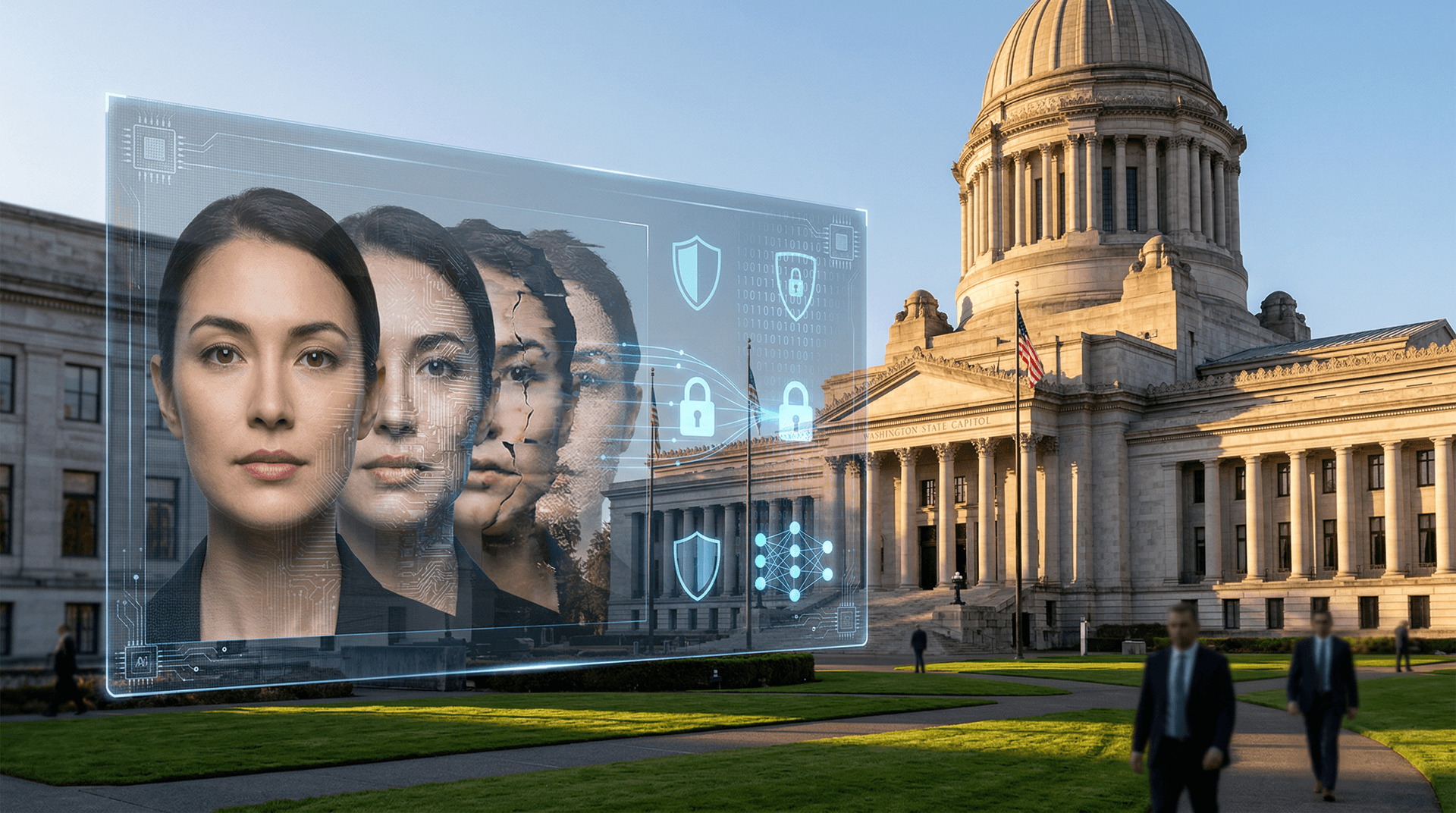
Washington AI deepfakes regulations took effect April 14, 2026. Governor Bob Ferguson signed Senate Bill 6299. It bans undisclosed AI-generated deepfakes in political ads. Violators face $10,000 USD fines per instance.
The law targets non-consensual deepfakes mimicking candidates. Platforms must label AI content clearly. The Public Disclosure Commission enforces rules.
Senate Bill 6299 Provisions and Rapid Passage
Senate passed the bill 32-15 on April 10, 2026. House approved it 78-18 the day before. Ferguson warned of deepfake threats in his signing statement.
National Law Review details the scope. Provisions cover generative AI in audio, video, and images. Platforms remove violations within 24 hours.
Deepfakes disrupted 2024 U.S. elections, reports Wired. Washington leads state-level responses.
Governor Bob Ferguson said, "AI tools amplify misinformation risks," at the ceremony.
Deepfake Detection Relies on ML Classifiers
Detectors use convolutional neural networks (CNNs) to spot pixel artifacts from generative adversarial networks (GANs). Audio tools analyze mel-spectrograms with transformers. Microsoft's Video Authenticator hits 90% accuracy, per 2025 MIT benchmarks.
Washington requires API integrations for real-time verification. Startups train supervised classifiers on FaceForensics++ datasets with 1 million samples.
Rep. Liz Berry, House Bill 2101 sponsor, stated during hearings, "Real-time detection demands edge computing."
Startups Capitalize on $150M Funding Wave
Washington hosts 12 deepfake detection firms. They raised $150M USD in venture capital through 2025, per PitchBook data.
Reality Defender closed $15M USD Series A last month. Its multimodal AI processes videos at 10x speed. CEO Ben Colman forecasts 25% revenue growth post-law, adding $10M annually at scale.
Sentinel (formerly Deeptrace) claims 95% synthetic detection in internal tests. It partners with state agencies.
TechCrunch notes 20% valuation jumps after California rules. Compliance drives $50M sector revenue by 2027.
Ben Colman told THJournal, "Regulations accelerate API adoption."
Crypto Markets Rally on Reduced Scam Risks
Bitcoin climbed 5.1% to $74,383 USD on April 14, 2026, via CoinMarketCap. Ethereum rose 8.0% to $2,368.61 USD.
Crypto Fear & Greed Index hit 21 (extreme fear), per Alternative.me. Investors see AI regs stabilizing cybersecurity.
Chainalysis 2025 report ties 30% of crypto scams to deepfakes. Reduced fraud cuts blockchain firm losses by 15%.
CrowdStrike stock gained 4.2% to $285 USD intraday.
State AI Laws Align with Federal Momentum
The law matches FCC's February 2026 AI robocall ban. Texas and Minnesota passed similar bills.
Experts predict 15 states follow by 2027. University at Buffalo's Dr. Siwei Lyu notes, "Disclosure lags advanced GANs," in his research.
Washington requires annual AI vendor audits. These spur microservices and DevOps tools.
Job Growth and VC Inflows Accelerate
Sequoia Capital led Hive Moderation's $20M USD Q1 2026 round. The law could create 5,000 verification jobs at $140,000 USD average salaries, per Glassdoor.
Incumbents leverage proprietary datasets. New entrants use open-source like DeepFaceLab.
Electronic Frontier Foundation's Natasha Duarte argues, "It ignores non-political deepfakes."
AWS Bedrock provides compliant scanning APIs.
Enforcement Budget Targets Compliance
Public Disclosure Commission budgets $2M USD for FY2027. It trains 50 staff in AI forensics.
Repeat violations draw $100,000 USD penalties. Courts support victim lawsuits.
Startups embed blockchain for content provenance. Deadlines start June 1, 2026, ahead of 2028 midterms. Expect 30% more funding rounds as compliance scales.