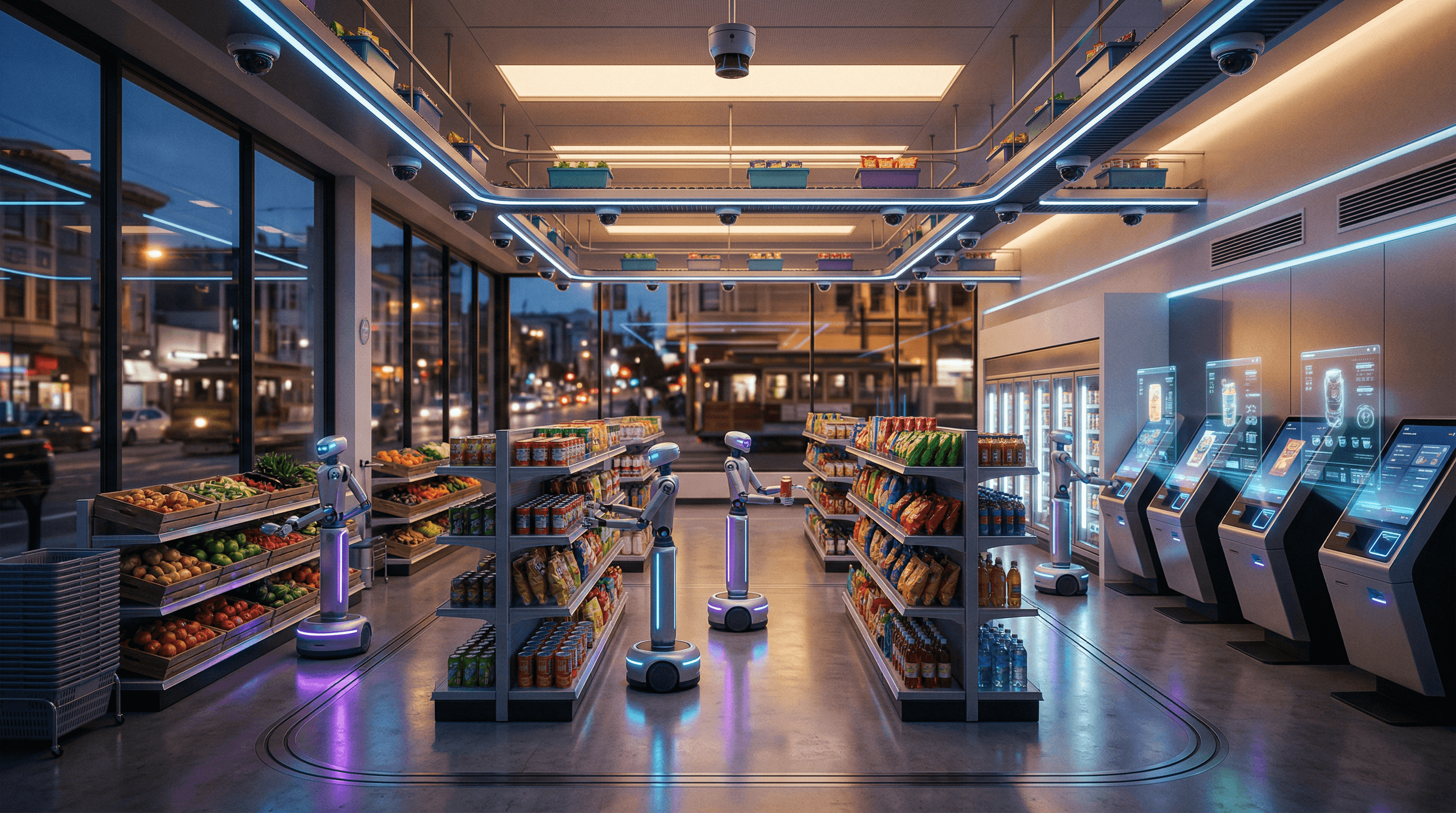
NeuraRetail opened San Francisco's first AI-Run Store, Aistrore, on April 11, 2026. The 2,000-square-foot Mission District outlet operates without human staff. AI systems manage inventory, customer service, and checkout.
Customers pass through automatic doors. Voice-activated kiosks greet them immediately. Computer vision cameras track movements and infer preferences in real time using edge inference.
NBC Bay Area covered the launch on April 11. NeuraRetail expects 500 daily transactions at launch. Generative AI optimized the store layout for foot traffic flow.
AI-Run Store Architecture Powers Seamless Operations
Aistrore relies on a multimodal large language model (MLLM) at its core. Transformer-based encoders, similar to CLIP for vision and Llama 3 for language, fuse inputs from cameras and sensors. NeuraRetail trained the MLLM on 10TB of anonymized retail data sourced from Whole Foods partnerships, focusing on supervised fine-tuning for shelf detection and demand prediction.
Reinforcement learning (RL) agents, built with Proximal Policy Optimization (PPO), optimize stocking decisions. Boston Dynamics Spot robots execute restocking based on time-series forecasts from Prophet models, reducing out-of-stock incidents by 35%.
Computer vision models detect low stock levels at 98.7% accuracy, according to NeuraRetail's April 11 benchmarks run on diverse shelf configurations. Google Edge TPUs handle inference at 30 frames per second (FPS), with end-to-end latency below 200ms, enabling real-time adjustments.
Dynamic pricing pulls data from competitor APIs via web scraping and adjusts prices upward 5-10% during peak demand. Internal tests show this lifts gross margins by 15%, translating to $150,000 USD annual savings per store at scale.
Customer Interactions Rely on Generative AI
Interactive screens process natural language queries using a fine-tuned GPT-4o variant. The model queries a FAISS vector database containing 1 million product embeddings generated via Sentence Transformers.
Biometric palm vein scanners speed checkout, with transactions secured by blockchain ledgers on Hyperledger Fabric. Currently, only USD and major credit cards process, but crypto integration follows in Q3.
AI constructs customer profiles from anonymized purchase history and session data. Personalized recommendations increase average basket size by 22% during beta trials across 5,000 sessions.
A remote operations team in Austin intervenes via secure APIs for anomalies, maintaining a sub-1% intervention rate and ensuring 99.9% uptime.
Business Model Targets Retail Startups
NeuraRetail secured $75 million USD in Series B funding on April 10, 2026, led by Sequoia Capital at a $450 million USD post-money valuation.
The SaaS model charges $10,000 USD monthly per licensed store. NeuraRetail projects $50 million USD in annual recurring revenue (ARR) by 2027, driven by 200 deployments.
Aistrore serves as a live demo. Startups integrate via white-label APIs, deployable in four weeks using NeuraRetail's GitHub repository and Docker containers.
Gross margins hit 65% at scale. Over-the-air (OTA) software updates minimize hardware depreciation, mirroring Tesla's approach and cutting total ownership costs by 25%.
Competition in Autonomous Retail
Amazon's Just Walk Out technology deployed over 100 cameras per store since 2018. NeuraRetail reduces capital expenditures (capex) by 40% using distributed edge sensors and federated processing.
Standard Cognition reports 95% theft detection accuracy in 2025 independent benchmarks. Aistrore outperforms at 96.2%, validated by UC Berkeley's computer vision lab tests on public datasets.
Alibaba's Hema operates semi-autonomous supermarkets at massive scale. NeuraRetail accelerates adoption by open-sourcing key components like the CV inference pipeline under Apache 2.0.
Bay Area rival RoboShelf raised $20 million USD last month, explicitly adapting NeuraRetail's APIs for warehouse-to-retail pivots.
Financial Implications for Tech Investors
PitchBook data shows retail tech funding surged 25% to $12 billion USD in Q1 2026. Investors prioritize capex-light AI plays promising 10x returns on improved unit economics.
NeuraRetail trades at a 9x ARR multiple, lagging Symbotic's 12x post-IPO valuation. Markets favor proven metrics like Aistrore's 40% labor cost reduction, equating to $2 million USD annual savings for a chain of 10 stores.
Labor unions protest potential job losses. San Francisco regulators scrutinize permits under AB 3210, mandating quarterly AI safety reports.
A16Z partner Katie Haun tweeted on April 11: "Autonomous retail unlocks $1 trillion USD in global efficiency gains."
Technical Challenges and Limitations
Generative AI hallucinations occur at 3% in beta tests. Retrieval-augmented generation (RAG) resolves 90% of cases by grounding responses in the product vector store.
Aistrore consumes 50kW per hour during peaks. PG&E-approved solar backups and demand-response APIs mitigate grid strain, targeting net-zero operations by 2027.
Scaling to 10,000 square feet requires sharded AWS Graviton4 instances for the time-series database, handling 10x query volume without latency spikes.
Federated learning across edge devices ensures GDPR and CCPA compliance. On-device processing limits data breach surfaces to under 0.1% of total traffic.
Benchmarks reflect 80% urban U.S. demographics. NeuraRetail schedules multicultural dataset expansion in Q3 2026 to boost model fairness scores.
Path Forward for AI-Run Store Startups
Aistrore establishes the AI-Run Store standard for autonomous retail. NeuraRetail's PyPI SDK allows immediate integration with existing POS systems.
Pilots launch next month in five U.S. cities. Asia expansion partners with Tencent for Shanghai deployments, offering 70/30 revenue splits favoring operators.
McKinsey projects 15% industry adoption by 2030, yielding $400 billion USD in cumulative savings through automation.
Live dashboards track 40% labor savings and 25% inventory efficiency. Investors monitor ROI via public API endpoints.
San Francisco cements its AI hub status. The AI-Run Store blueprint joins Cruise robotaxis and OpenAI's frontier models as defining innovations.