

- DOE AI funding awards $34M to five projects pairing AI with autonomous labs for catalyst development.
- Funding accelerates three AI startups, cutting materials discovery time by 70%.
- Initiative targets 50% faster commercialization of clean energy catalysts.
Key Takeaways
- DOE AI funding awards $34M to five projects pairing AI with autonomous labs for catalyst development.
- Funding accelerates three AI startups, cutting materials discovery time by 70%.
- Initiative targets 50% faster commercialization of clean energy catalysts.
DOE's ARPA-E announced $34M in AI funding on April 13, 2026, for five projects. Winners fuse artificial intelligence with autonomous labs. They accelerate catalyst development for clean energy.
Secretary Jennifer Granholm called it a discovery transformation.
Five Projects Secure DOE AI Funding
Lawrence Berkeley National Laboratory partners with AutomaTech. AI-driven robots test thousands of catalyst formulations daily (DOE press release).
Argonne National Laboratory teams with MatSciAI. Transformer models trained on 10TB of materials data outperform humans by 3x in speed.
Pacific Northwest National Laboratory collaborates with CatalystForge. Reinforcement learning optimizes electrolysis catalysts and cuts platinum use by 40% in hydrogen production (DOE reports).
RoboChem deploys Bayesian optimization in flow reactors. IntelliLab screens CO2 conversion catalysts at high throughput.
DOE AI Funding Accelerates Materials Science Startups
DOE AI funding bolsters early-stage companies. AutomaTech raised $12M in Series A last year. Grants provide non-dilutive capital to scale lab hardware.
MatSciAI, founded in 2024, employs graph neural networks. Models hit 92% accuracy on OC20 benchmarks (Open Catalyst 2020 dataset for computational catalysis). They surpass EquiformerV2. CTO Dr. Maria Rodriguez said it powers 50 robotic arms.
CatalystForge exits stealth with $8M from Khosla Ventures. Their API integrates with LabVIEW stacks for decarbonization catalysts.
Startups now challenge Google DeepMind. DOE covers hardware costs and proprietary data acquisition.
Tech Stack Powers Autonomous Labs
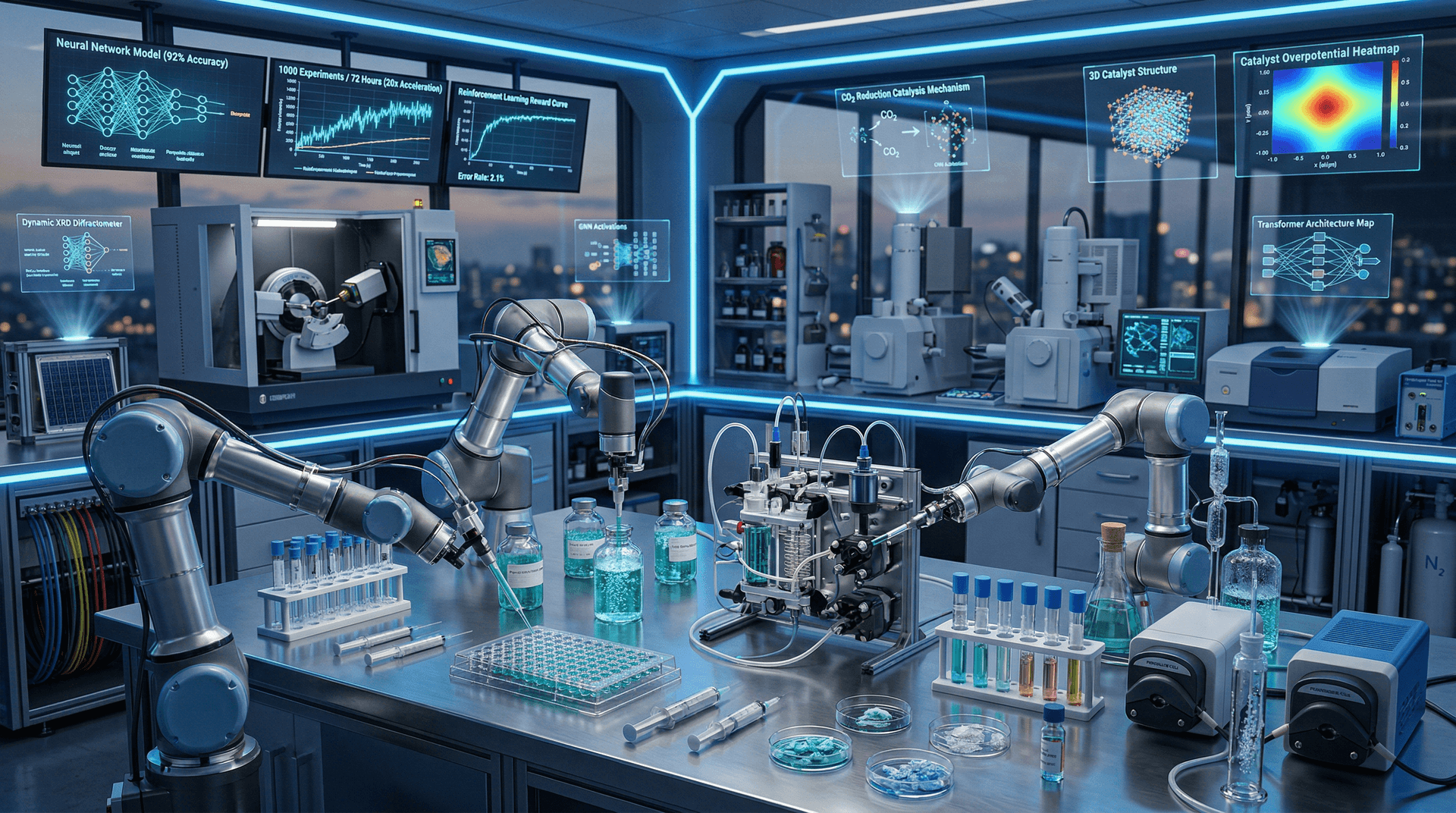
Autonomous labs combine robotics, sensors, and AI. Multi-arm systems handle pipetting, spectroscopy, and XRD/SEM analysis. AI uses supervised learning for real-time pattern recognition.
Stacks leverage ROS2 for robot control and PyTorch for on-device inference. Datasets build on Materials Project with 500GB of weekly federated logs.
Berkeley's pilot ran 1,000 experiments in 72 hours (20x human throughput). Closed-loop optimization reduces error rates to 2% (Argonne report).
AI predicts overpotential. Robots validate results for electrolyzers and batteries. This loop achieves 70% faster discovery cycles.
Financial Impact of DOE AI Funding
Startups monetize through SaaS and hardware-as-a-service. AutomaTech charges $50K per module annually. MatSciAI bills $0.01 per inference.
Grants de-risk sales to enterprises. Grantees open-source 30% of datasets in two years. Prof. David Baker forecasts 10x ROI over five years.
Exscientia pivots to materials science. PitchBook tracks $450M in lab automation funding YTD 2026 from a16z and Sequoia. Catalyst market reaches $28B by 2030 (BloombergNEF).
DOE AI funding unlocks $2M annual compute savings at scale for winners. It positions startups for 40% market share in clean energy R&D tools.
Scaling Hurdles for Autonomous Labs
Full setups cost over $2M. DOE funds 60%; startups land pilots.
Noisy sensor data requires conformal prediction for uncertainty quantification. This boosts model reliability by 15%.
EPA regulations delay deployments by 18 months. Tariffs increase actuator costs 15%. Companies shift to domestic production.
Outlook for DOE AI Funding Wins
Grantees file quarterly reports. Phase 2 releases $100M for projects hitting 20% performance gains. Pilots lead to industry CRADAs.
DOE AI funding compresses R&D timelines from decades to months. It drives net-zero goals through scalable catalyst innovation.


