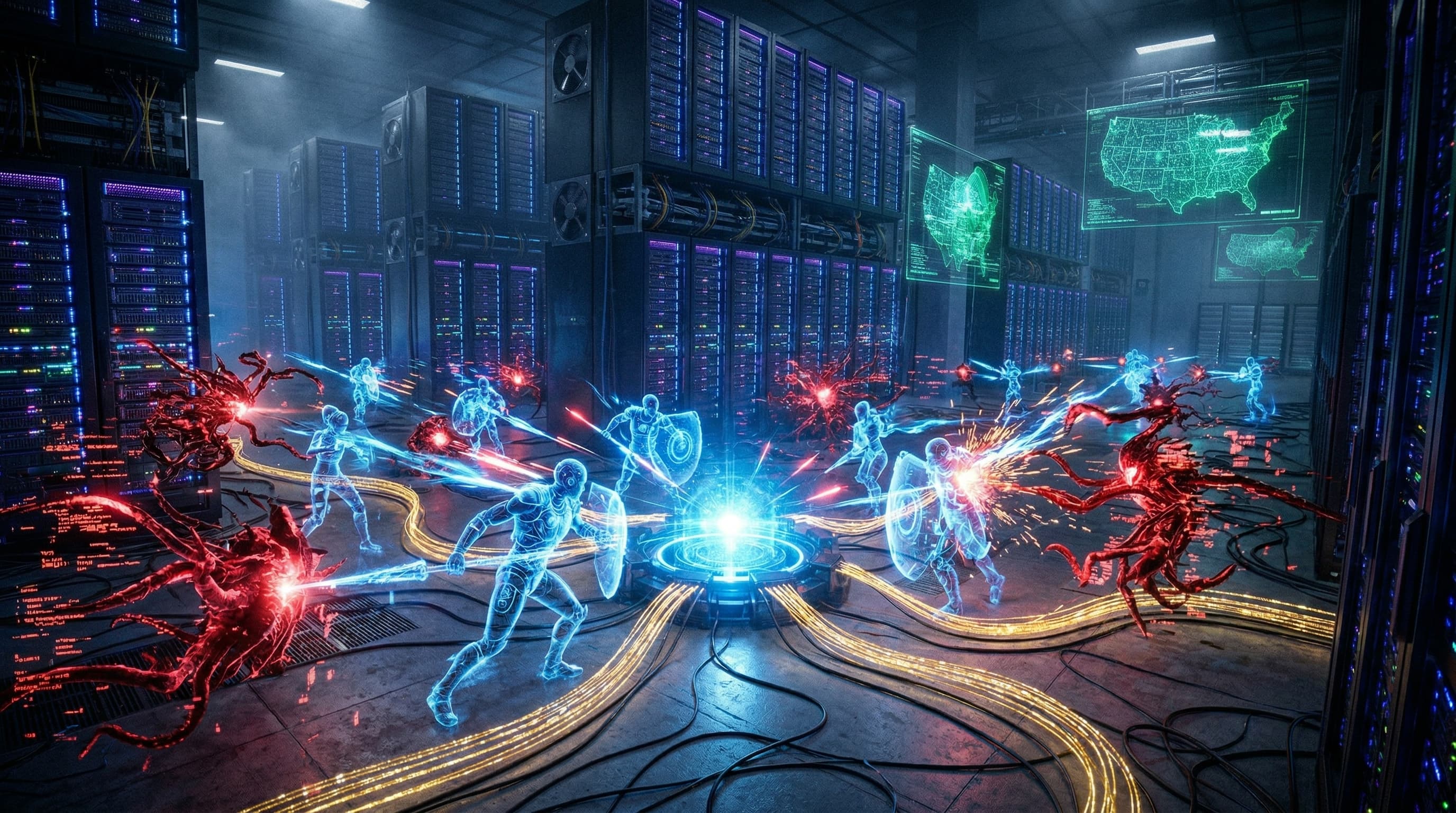
Cybersecurity leaders from Palo Alto Networks and CrowdStrike predict autonomous AI agents will defend networks by 2028. Announced April 11, 2026, at the Cyber Defense Summit, demos show 40% faster threat response.
Advances in multi-agent AI systems drive this prediction. Current tools demand human oversight for threat hunting. Autonomous AI agents hand control to machines that learn from attacks in real time.
Technical Foundations of Autonomous AI Agents
Autonomous AI agents combine large language models (LLMs) with reinforcement learning (RL). Developers train them on datasets like MITRE ATT&CK framework simulations. Each agent specializes in tasks such as anomaly detection or lateral movement blocking.
Palo Alto Networks demonstrated Cortex XSIAM 3.0 on April 11, 2026. This platform deploys agent swarms that communicate via APIs. Benchmarks show 40% faster threat neutralization than rule-based systems (Palo Alto Labs, April 11, 2026).
Agents employ transformer architectures for decision-making. They process network logs, endpoint telemetry, and cloud metadata. RL algorithms reward successful defenses, enabling adaptation to zero-day exploits.
Real-World Deployments Emerge
CrowdStrike rolled out Falcon Agent Swarm on April 11, 2026. The system countered a simulated ransomware attack in 12 seconds. Human analysts required 45 minutes (CrowdStrike internal tests).
Startups lead innovation. SentinelAI raised $50 million USD in Series B funding last week. Sequoia Capital invested. The firm deploys agents on AWS and Azure infrastructures.
Darktrace employs similar tech in Antigena 7.0, released April 11, 2026. It autonomously isolates compromised nodes. Adoption grew 25% year-over-year (Darktrace Q1 2026 earnings).
Finance Angle: Surging Investments
Venture capital poured $12 billion USD into AI cybersecurity in Q1 2026 (PitchBook, April 11). AI-driven startups captured 60% of deals.
Public markets signal optimism. Palo Alto Networks stock climbed 3.2% to $450 USD per share on April 11. CrowdStrike rose 2.8% to $380 USD. Analysts project 28% CAGR for AI cybersecurity through 2030 (Gartner, April 2026).
Automation slashes costs. Traditional SOC teams cost $5 million USD annually (Forrester, 2026). AI agents cut this by 35% via fewer false positives.
Challenges in Agent Autonomy
AI agents grapple with reliability. LLMs hallucinate threat assessments in 5% of cases (NIST, March 2026). Adversaries craft inputs to mislead models.
Explainability lags. Regulators require audit trails under EU AI Act updates. Agents must log decisions in human-readable formats.
Scalability strains resources. Large networks generate 10TB of logs daily. Agents demand GPU clusters costing $1 million USD yearly (IDC estimates).
Integration with Existing Architectures
Zero-trust models integrate seamlessly with agents. Agents verify every packet autonomously. Zscaler APIs enable smooth deployment.
Cloud providers boost adoption. AWS Bedrock Agents launched templates on April 11, 2026. Azure Sentinel supports custom RL training.
Open-source tools empower developers. LangChain Agents 4.2 added cybersecurity primitives. GitHub stars reached 50,000 this week.
Leading Competitors
Microsoft leads via Defender AI Agents. The platform blocked 2.5 billion threats in Q1 2026 (Microsoft Security report). Google Chronicle deploys agent-based SIEM.
Qihoo 360 deploys agents in China. Export restrictions curb global reach. US firms dominate enterprise markets.
Vectra AI disrupts with network traffic analysis. Its agents apply graph neural networks for hidden threats.
Future Roadmap and Predictions
Experts predict full autonomy by 2028. Agents will forecast attacks via federated learning across firms. Homomorphic encryption safeguards privacy.
Quantum threats emerge. Agents counter harvest-now-decrypt-later attacks. NIST standards guide RL for post-quantum crypto.
Enterprises pilot now. JPMorgan tests agents on trading networks (Wall Street Journal, April 10, 2026). Finance leads due to high stakes.
Market Projections
Gartner forecasts $150 billion USD cybersecurity spend by 2030. Autonomous AI agents claim 40% share. ROI reaches 300% in 18 months (IDC, April 2026).
Talent shifts unfold. SOC roles evolve to agent oversight. AI security engineer demand surges 50% (LinkedIn Economic Graph, Q1 2026).
Regulations spur growth. US CISA mandates agent pilots for critical infrastructure by 2027.
Autonomous AI agents launch cybersecurity's proactive era. Networks deploy intelligent shields. Defenders seize the initiative from attackers.